LIfesong Wilderness Adventures

Wilderness Survival Training for Adults in Oregon

  • Survival Skills Training
  • Oregon Survival School
  • Custom Survival Training
  • Contact Us
    • Registration Policies
    • FAQ
    • Getting to Camp
  • About
    • More Services – Gear, Rentals, etc.
      • Business Information
      • Privacy Policy
      • Recommended Links
  • Calendar
    • Media & Press
  • BLOG
    • The Philosophy
    • Outdoor Survival School
    • Plants
    • Survival Gear
    • Tracking
    • Teen Adventure Camps

Feb 08 2023

Predators Fang

Predators fang. Elk in clear cut - Oregon 2007
Roosevelt Elk in Oregon clear-cut:

"As poet Robinson Jeffers has noted, it is the fang that has created the fleet foot of the antelope." Listed below is information about the importance of natural predators for the health of prey animals.

Predator's Fang

The Benefit of Predators

"In general, hunters take animals in the prime of life, while predators disproportionately take out older, younger, or less fit individuals.

Predators can also limit the effects of disease. Diseases like Chronic Wasting Disease found in elk, deer, and moose since infected animals are more vulnerable to predators." ~ by George Wurthner

Chronic Wasting Disease

"Chronic Wasting Disease, otherwise known as (CWD), is a prion disease that affects several cervid species: deer, elk, reindeer, sika deer, and moose. "

CIDRAP  Chronic Wasting Disease Update 2026

How You Can Help

Colorado Parks & Wildlife CWD Video Series

What Hunters Can Do

Mississippi State CWD video series

Butchering Your Kill

How to butcher your kill if you are concerned with Chronic Wasting Disease (CWD)

  1. Be alert for deer or elk acting abnormally, or that look sick; report any such animals to agency officials.
  2. Wear rubber or latex gloves when you field-dress your animal.
  3. In areas reported to have CWD, minimize your contact with a dead deer's brain and spinal cord and wash your hands after contact.
  4. Don't eat deer brains or spinal cord.
  5. Bone out your deer meat and discard the brain, spinal cord, eyes, spleen, and lymph nodes.
  6. If an animal is from a CWD-suspect area, unused parts, especially skull and spine, should be disposed of in an approved landfill or incinerator.
  7. "In many parts of the country, the deer population has grown out of control, causing tens of thousands of deer-related car crashes and the destruction of natural habitat."  By Sean Page

Hunting in areas with known CWD

"If you’re hunting in an area with chronic wasting disease, get the animal tested before it ever hits your plate, and don’t eat meat that tests positive." ~Brent Race - High Country News

Predators Help Manage Disease

Manage for and maintain a diverse and healthy Ecosystem, which of course must also include two of nature's historically proven management tools; the Wolf and the Mountain Lion.

The Wolf

Wolves, by design, keep deer and elk populations strong and healthy.

MME's

Mass Mortality Events. What are MME's?

In conclusion

The demands on wildlife are great. With Chronic Wasting Disease spreading across the United States. Predators, by their very nature, are disposed to kill and consume the weak and sick. This process is tens of thousands of years old. It's the original wisdom.

Links

  • What is Giardia?
  • Tips on Ticks
  • Oregon's Most Toxic Herp
  • Shadow Wolves
  • Teen Conservation Project
  • Living the Wilderness Way
  • How to Track Wild Animals

Written by Mark J. · Categorized: Tracking

Sep 01 2020

Visual Man Tracking

Visual Man Tracking

Visual Man Tracking in action: A Search and Rescue Tracker, applying ancient tracking skills, scans the area for clues that show "Spoor," or evidence, of a lost person's trail.

What is Visual Man Tracking?

"Visual Man Tracking" is an ancient hunting technique still in use today for locating and trailing wildlife. But in modern parlance, you will most often find this term related to Tactical and Search and Rescue Mantracking.

What exactly is "Spoor?"

According to Wikipedia, "Spoor is a trace or a set of footprints by which the progress of someone or something may be followed. Spoor may include tracks, scents, or broken foliage."  ~Wikipedia

Tracker

A Tracker uses his eyes to visually locate clues generated by the missing person's movement over the ground. The arrow symbol made of sticks in the photograph is from an actual search. The person who left this clue for searchers had her thinking cap on.

Examples of clues

  • Clothing can be snagged on bushes leaving a bit of colored thread along the trail.
  • Personal Items: Belongings of lost persons may be accidentally dropped or even left on purpose.
  • Sticks and branches: Broken branches or symbols built on the ground show the direction of travel.
  • Footprints: The most common evidence a tracker scans for during a search is the lost person's tracks.

Use your natural senses in Visual Man Tracking

Vision is not the only tool used. All our natural human senses are employed in man tracking.

  • listening - the missing person calling for help
  • smell - perfume - cigarette - campfire smoke
  • voice - calling out - yelling
  • touch - hot & cold
  • vision - seeing spoor

Elements of Visual Man Tracking

  1. Spoor recognition & identification
  2. aging Spoor - timeline
  3. trailing - following Spoor
  4. locating subject

Subject's Description and Information

A description of the missing person is vital to searchers. When Spoor is found the Tracker must decipher this information by adding the pieces together, and decide if the Spoor fits the identification elements of the missing person.

"The number one (1) most important element in Visual Man Tracking, is to distinguish Spoor belonging to the subject of interest from Sign that is unrelated.

Aging Spoor

Is Spoor fresh or old? A Visual Man Tracker can differentiate between fresh and old Spoor. Aging spoor means to distinguish Sign that looks promising, from the real thing. But a trained Tracker can tell if a shoe print was laid down minutes, hours, days, weeks, or months before

How to Age Spoor

To understand "Aging Spoor," Trackers study a variety of objects such as twigs, grasses, leaves, and tracks. They spend minutes, hours, and days watching the slow process of change or decay to the Spoor. Using this mental exercise over time, The Visual Man Tracker develops the ability to predict the age of Spoor with confidence.

Example of Aging Spoor

In this example, we are aging the remnants of a dead campfire. The campfire is in the middle of a heavily rocked logging road.

The question is; was the campfire made by our lost person? Did it fit the timeline? How do we know?

Applying the Skills of a Visual Tracker

  • Is there a strong smell of wood smoke in the air?
  • Are the ashes, charcoal, and burned sticks still warm to the touch?
  • Do we see the subject's fresh prints in and around the fire area?

If we answer Yes to these questions; we can then answer the important question with surety. Yes, the campfire fits the missing person's timeline.

Aging factors

Weather has a profound effect on Spoor. Sunlight bleaches color, wind can distort, and rain washes the track away. As Spoor ages, Sign recognition becomes more difficult.

Going Deep into Aging Sign

Using our campfire example, let's assume the campfire was cold. The ashes, charcoal, and sticks are cold to the touch. If there were shoe tracks in the ash, the rain had long since washed them away. However, we can still smell the faint scent of wood smoke in the air. The smell is subtle. But it's there. And if we look closely at the burned wood in the campfire, we determine through aging techniques, that the sticks have been freshly gathered.

A close inspection and aging of the abandoned fire proved the fire to be out. The Spoor fell within the timeline of the missing person. The conclusion? The campfire is Spoor from our lost person.

Trailing Spoor

Visual Man Tracking is following, or "Trailing" clues left behind by the person's passage. The Spoor trail can be a single clue such as our campfire example, or a variety of Sign.

Broken Twig Visual Man Tracking Spoor
This conifer branch was deliberately broken by a lost person to help searchers find her.

Spoor such as footprints, clothing, broken twigs, pushed-down grasses, a beer can, or in the case of a smoker, a freshly discarded cigarette butt, can be a clear Sign. In the best tracking circumstances, Spoor is easily found and available. But the reality is the opposite. Trailing is a mix of clues and nothing found. Human tracks disappear under grasses or are removed by weather. Often, the hard compacted ground makes it difficult to impossible for trailing

Trailing on Difficult Terrain

Gravel roads and rocky terrain are especially difficult for Trailing. Some soils, such as compacted clay washed by rain, are examples of difficult substrates to trail. In the photo below, the Man Tracker recognizes the Cedar branchlet as a Spoor left by the lost person. The Visual Tracker can recognize Spoor deliberately placed.

Trailing Spoor
Cedar branch in middle of photograph left by lost person.

Locating the Missing Subject

There are many variables to locating a lost hiker. Valuable information is needed to begin an earnest search in the correct area. Where was the person last seen (PLS)? Did they leave a note indicating where they have gone hiking? Who saw them last? Were they alone or with someone else?

The questions are many and getting the right answers are key in locating the missing person. By recognizing Spoor and Sign, the skilled Visual Man Tracker has a good chance of locating the missing subject.

Track Studies

Track studies are an integral part of a student’s training in Visual Man Tracking. In these photo examples tracks show the direction of travel. Is the subject stepping straight ahead or to the left or right?

Track study in snow.
Track study in snow. What is the direction of travel?
Visual man tracking in snow study.

In what direction is the subject is going?

What happened here?

What does this Track tell us?

In Conclusion

Tracking can be explained as interpreting human (or animal) presence and passage upon the landscape. The terms: Visual Man Tracking, Man Tracking, Trailing, and Spoor. Encompass all of the elements of ancient tracking skills but are most often used in more formal settings such as in Search and Rescue operations or by military tactical teams.

Successfully finding a lost person takes training. It takes time, hands-on practice, and dedication to become proficient in the skills required. Visual Man Tracking is rewarding.

Our tracking classes highly benefit SAR members who wish to increase their teams' ground tracking ability.

If you can imagine actually finding a lost person, whose best hope lies in the success of your skills along with other dedicated Trackers, Lifesong Wilderness Survival welcomes you to dive in, thrive, and master your tracking and survival skills.

Begin with First Circle Camp.

  • Mountain Lion Facts for Search and Rescue
  • What Animal Made This Track?
  • Animal Sign Language
  • Emergency Shelter Class


Written by Mark J. · Categorized: Tracking

Jun 17 2020

Shadow Wolves

Shadow Wolves showing bear track photo

"In brightest day, in darkest night, no evil shall escape my sight, for I am the Shadow Wolf"- U.S. Customs Patrol Officer motto. 

Shadow Wolves

Who are the Shadow Wolves? They are expert trackers of the desert. Skilled in the ancient way of ‘Sign Cutting '.

Shadow Wolves track smugglers and human traffickers along the US Mexico Border—members of tribes such as the Sioux, Navajo, Lakota, Kickapoo, and Chickasaw. The Pima and Tohono O’odham tribes are Shadow Wolves.

Indigenous trackers are children of the wilderness. It is said they know how to read its subtle message.

They learned from their elders that it is possible to "hear" things that are silent and to "see" things that are invisible on a trail."

Tracking Skills

In modern times, Tracking is considered a science. However, for thousands of years, humans depended on tracking skills to trail the animals they hunted.

Tracking is a core survival tool. A tool that helped our ancestors learn valuable information about the environment, habitat, and the wildlife they hunted.

Trailing and Sign Cutting

Shadow Wolves use tracking techniques called Trailing and Sign Cutting. Tracking skills warned the warrior-tracker of the enemy's presence. And the whereabouts of those who might cause harm to the people.

How to Learn to Track

The basics of tracking can be learned from books along with plenty of field studies trackers call, dirt time.

Tom Brown's Field Guide to Nature Observation and Tracking is an excellent resource. Brown's book provides a good foundation in sign tracking and nature observation.

Shadow Wolves follow Sign

Pictured below is a "Leaf study". This is "SIGN" to the Shadow Wolf. This photograph shows how leaves stand after a tennis shoe has 'released' from the ground. Leaving a "Sign" of the person's passage. I took this photograph using a Micro setting.

To recognize and follow "SIGN", you must look closely.

Man Tracking pine needle leaf track study. Photo by Mark J Wienert.

For some Indigenous peoples, Tracking is a way of life

Tracking is a way of life that gives the Shadow Wolves their powerful skills.

For a Shadow Wolf, his life and his team's survival depend on his ability to read the landscape in a way that he can feel and sense the spirit of the track...of his quarry. 

In Conclusion

The good news is that you can begin learning to track at any age. The personal benefits of tracking are many and can be applied to all aspects of your life.

Tracking skills, I believe, are one of the most important survival skills you can learn. Join us for the introduction to Animal Tracking.  Skills you must develop to track like a Shadow Wolf.

  • Living Wilderness Way
  • Visual Man Tracking
  • Cold Water Therapy
  • Predators Fang

Written by Mark J. · Categorized: Tracking

Feb 20 2017

How to Track Wild Animals

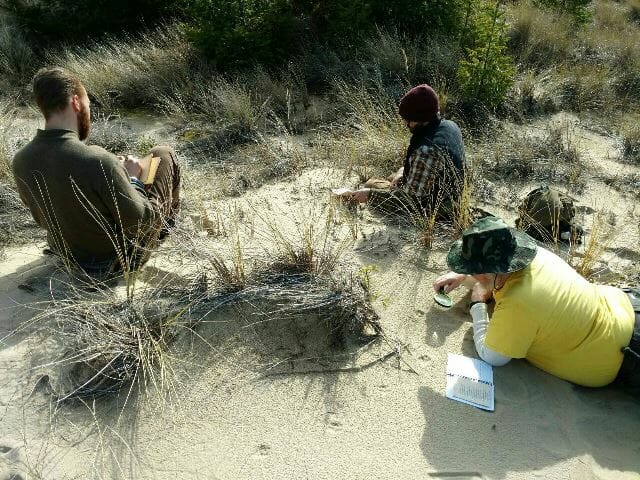
How to Track animals. Students studying animal tracks in sand dunes.

Tracking is a fun way to discover and learn about animals and their behavior. The more you track Animals the more you will learn about them and the life they live. Learning how to Track is an ancient survival skill and the skill our ancestors relied upon to live, hunt, and forage.

How to track animals

As we learn to Track we discover Sign and movement of wildlife. Recently our Oregon students mapped out coyote, gray fox, feral cat, birds, chipmunk, mouse, and bobcat.

The discovery of wildlife is made easier through the skills of Tracking.

Tracking is Science and Art

Tracking is precise. The science of Animal Tracking require measurements to distinguish between animal tracks of the same family. As an example the Dog family Canidae, measuring the width and length of a track correctly tells us if the animal is a Fox or Coyote.

Tools to measure and document tracks in the field

Tools are helpful in measuring and documenting an animal's print, stride, and trail width for identification.

  • ruler
  • tape measure
  • notebook
  • pencil & eraser
  • scotch tape (For collecting animal hair)
  • camera

Animal sign

Animals leave Sign as they live and pass over the landscape. Developing recognition of an animal's presence on the landscape reflects our ability to learn the meaning of these terms.

  • scrapes
  • scratches
  • rubs
  • digs
  • hair
  • scat
  • trail
  • gnawing's

A bus driver and hunter

One of our new students is a bus driver and avid deer hunter from Eugene, Oregon. John had this to say about his newly developed tracking skills.

"Thank you, Mark, for a wonderful experience. I learned more about tracking in 2 days than I have in 40 plus years of hunting."  ~John Hampton

Thanks, John., We love to hear comments from our students. At Lifesong Wilderness Adventures our focus is to increase student's Tracking Skills, dramatically.

Survival skills

Tracking helps us discover the animals that visit our backyard and neighborhood and still is a valuable skill for hunters, photographers, and nature enthusiasts. As for me, I believe learning how to Track is one of the best survival skills a person can learn.

Learn to Track Wildlife

Are you ready to be a Tracker? Register for our Oregon Intro and Advanced Animal Tracking.

Recommended books and posts on learning to track animals

  • Tom Brown's Field Guide to Nature Observation and Tracking by Tom Brown
  • Tracking and the Art of Seeing by Paul Rezendes
  • Sign language - reading natures clues with Mark Wienert

Read On

  • How to Brain Tan a Squirrel
  • Learn More About Mark Wienert

Written by Mark J. · Categorized: Tracking

Apr 20 2011

Bears Bear Ursus

Bear Bears Ursus

Bears bear Ursus. Spring is here, and humans are exiting home and hearth while Bears leave their winter dens. Accidental encounters of a scary nature happen between humans and Ursus during this time. First, a little background information on Bear, Bears, Ursus, and his behavior to help you understand and safely plan your next wilderness adventure.

Bears Bear Ursus

The three-bear specie associated with North America and the ones you are most likely to encounter are the Black bear (Ursus americanus), Brown/Grizzly bear (Ursus arctos), and Polar bear (Ursus maritimus).

Bear Bears Ursus.
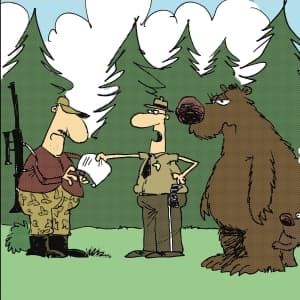
“That’s right! – – a restraining order. You should know mother bears are very protective of their young.

Grolars

Let's add one tiny little exception to that and the discovery of hybridized grizzly bears and polar bears...Grolars. Ursus inopinatus, which is far from official, and while the scientific wheels turn slowly bears just keep being bears. It looks like some of them think the ice queens are hot.

Lifesong Wilderness Adventures makes you bear aware.

The possibility of running into a bear is minimal, but occurs, and in any event, it is wise to be prepared. What follows is information for you about bears, their nature and behavior, and ultimately how they might affect your outdoor experience.

Bears Bear Ursus relationships

Bears mate anywhere from April through June and monogamy is not high on the list for females. However, the males do their best to maintain territorial rights and often herd the females away from other possible suitors.

Speaking in generalities, female black bears do not mature until around the age of four. Grizzlies six to eight years of age, and polar bears between three and five years. This is when mating occurs. Bears typically breed once every four years after attaining maturity and have very low birth rates.

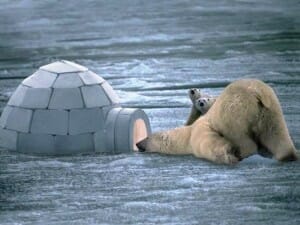
Example of Polar Bear den
Polar Bear Den
Polar bear and cubs looking into igloo
Crunchy on the outside, chewy in the middle.

Half-pregnant

There is a very, very old joke that you can't be half-pregnant, but bears and other mustelids prove this statement false. After fertilization, the embryo (called a blastocyst) stops growing, avoids implantation, and surfs the uterine fluids until mom heads into winter slumber.

If she is in good physical condition, the embryo will implant, and she will give birth in January or February; if not, she will abort. This is nature’s way of maintaining a balance between birth rates and available food.

Successful birthing brings one to four cubs for black and grizzly bears, and polar bears one to three; twins are the average for all.

Myth #1

All mother bears are cranky and dangerous. NOT true. Many black bears will not come to the defense of their young for any reason; and a grizzly mom might feel threatened just by your presence in her vicinity, whereas mother polar bears eat anything and everything in sight, including humans, generally speaking.

Cubs spend from one to three years with mom.  A sow (female bear) does not come back into estrus until she kicks the cubs to the curb, leaving them to run amok like teenagers at Disneyland.

Up until the cubs are weaned, they learn how and what to eat from mom by following, observing, and smelling her snout for residue.  Do you ever wonder why your dog has his nose in your face or ummm...in other key areas; it is to determine what you've been eating.

Myth #2

Bears have poor eyesight, NOT true.  Bears see as well as humans during the day but have the same capable night vision as cats and dogs which, have a reflective layer, called the tarpetum lucidum, lining the back of the eyeball.

This layer reflects light back through the retina, allowing the light to stimulate the rods a second time, thus improving night vision.

Bears also have color vision, like humans, which helps identify foods.  Polar bears have the best eyesight and have adaptations that allow them to see underwater and filter snow glare.

A bear's hearing and sense of smell is extremely sensitive and acute.

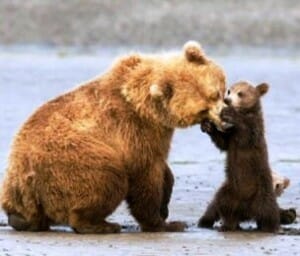
Adult female grizzly bear with cubs.
Whatcha been eatin mommy?

Bear Bears Ursus

"A black bear in California was once seen to travel up wind three miles in a straight line to reach the carcass of a dead deer."

". . .male polar bears march in a straight line, over the tops of pressure ridges of uplifted ice . . .up to 40 miles to reach a prey animal they have detected."

Bears can smell your bacon cooking

Bears have additional help with smell via a Jacobson's organ in the roof the mouth.

The vomeronasal organ or Jacobson's organ can be found in all vertebrates. While snakes and other reptiles flick substances into Jacobson's organ with their tongues, several mammals (e.g., cats) exhibit the Flehmen reaction.

When 'Flehmening', an animal appears to sneer as it curls its upper lip to better expose the twin vomeronasal organs for chemical sensing.  Deer, horses, monkeys, and bears do not use it simply to identify minute quantities of chemicals, but also for subtle communication between other members of the same species, through the emission and reception of chemical signals called pheromones.

Most notably, pheromones are emitted during estrus, but there are also alarm pheromones signaling stress or fear, food trail pheromones (how do you spell rotten meat), and many others.

Early scientific studies deemed humans did not use this organ, but recent studies show that's bogus.

"There are indications that Jacobson's organ may be stimulated in pregnant women, partially accounting for an improved sense of smell during pregnancy and implicated in morning sickness."

Bears, bear ursus, are omnivorous

Bears are omnivorous, which means, like humans, they eat both plants and animals, with a polar bear being the exception for obvious reasons.  However, and it's a big however, bears are predominantly herbivores and feed on newly emerged grasses, plants, bulbs, and sap from trees.  Bears had an affinity for maple syrup long before humans.

Black bear sitting on picnic table
Guess who's coming for dinner?

Conflicts with bears

Humans and bears come into conflict over food sources. If you built your house on last year's berry patch, expect a visitor; just be sure you don't provide an alternate food source like a bird feeder full of rich sunflower seeds.

Learn to Identify Black Bear tracks and sign

  • What Animal Made This Track?
  • Black Bear Videos with Mark J Wienert

In conclusion

The information provided here on Bears is valuable and helpful, but it is no substitute for the hands-on personal training First Circle Camp provides.

Additional reading.

  • Mountain Lion Facts
  • Summertime Berries
  • Reading Nature's Clues
  • Man Vs Wild

Written by Mark J. · Categorized: Tracking

  • « Previous Page
  • 1
  • 2
  • 3
  • Next Page »

Lifesong Wilderness Adventures

PO BOX 149
Blue River OR 97413

Monday-Friday 9AM-5PM PST

Contact Mark

Privacy Policy - Media and Press

Lifesong Wilderness Adventures Oregon Survival School Logo.

Sitemap

Guide Outfitter Recognized Professional Mark J Wienert.

Guide Outfitter Recognized Professional

Mark J Wienert

Copyright © 1994-2026 · Lifesong Wilderness Adventures · All rights reserved.